Roller Network will be observing the Thanksgiving holiday on November 24th and 25th. During an observed holiday technical support response times may vary depending on the service level. Our next regular business day will be on November 28th.
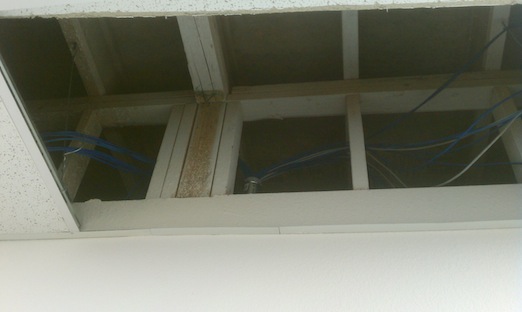
One question we’re frequently asked on tours is if our walls extend (or “cut”) past the false ceiling. The answer is yes; all of our walls extend the full height up to the floor of our mezzanine level, and the remaining overhead spaces are too narrow for someone bypass doors by going through the ceiling. At the same time, we do not permit unescorted site access.

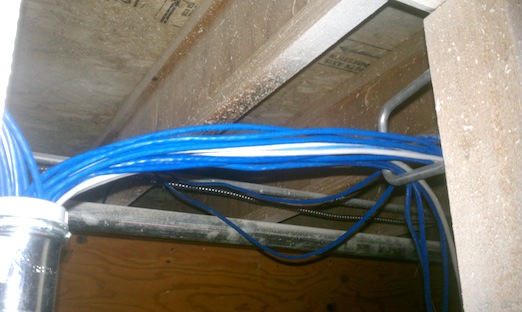
Many times businesses will save money on construction costs by only building up to the bottom of a false ceiling, but since our facility is an integral part of our services we always opt to cut the ceiling. We also dress overhead wiring with d-rings even though it’s hidden.

A question came across the forums last week about address extensions (user+ext@example.com) not working because it wasn’t filing into folders automatically based on the extension part. They do work, but that anticipated behavior is actually a modified one rather than standard, but such a thing can be accomplished with Roller Network hosted mail boxes and a quick Sieve script:
require ["fileinto", "variables"];
if header :matches "Delivered-To" "user+*@example.com" {
fileinto "${1}";
stop;
}
else {
keep;
}
Add this using the managesieve online interface (or managesieve plugin that allows direct entry), replacing “user” and “example.com” with entries appropriate to your hosted mail box. This script will automatically file anything with an extension into a folder of the same name or default to INBOX if there wasn’t an extension.
We have been considering adding this functionality as a per-mailbox account control center option, but a Sieve script will quickly do the job just the same without having to wait for us.
A Year With Utility Power
It dawned on us that it’s been a while since we’ve had a power outage or phase imbalance requiring us to switch to generator power (although we do test every two weeks on load), so we did some digging and discovered that indeed the last time there was a utility power outage was back on October 24, 2010.
Over the last year we’ve only observed minor power flickering during weather and at least one lightening strike that caused a citywide (as observed by all of our remote monitoring points simultaneously) hiccup. All of these events where cleaned up by our online UPS system without going to battery.
Colocation Power Updates
All power to full racks will now be provisioned with 20 amp 208 volt three phase service with a three phase PDU. The pricing and power offered will remain the same, but the upgrade from included power will now be a “soft” (billing) change rather than requiring the outlet and PDU to be physically replaced. We feel that this will cover the vast majority of full rack power needs. Upgrading to 30A three phase will still be a “hard” upgrade requiring a a 30 amp circuit and PDU to be installed.
Half racks will remain a 20 amp single phase service due to space restrictions: the three phase PDUs are full rack height while the single phase models are half-height. This allows us to pre-populate racks with the most common power and PDU configurations rather than waiting until the time of order to see if a customer wanted single phase or three phase power to their rack. The net benefit to our customers is faster half rack and full rack availability.
Roller Network provides PDUs and power cords with our colocation service since we use circuits and voltages that are not commonly offered as standard features for most colocation providers in the United States. We provide the infrastructure, you provide what goes in the rack. Roller Network makes it that simple.